- 1.5 kmToe of the Glacier trail, return
- 3.4 kmWilcox Pass to the red chairs, return
- ~175 mWilcox Pass elevation gain
- 1.5 kmGlacier retreat since about 1900
The Free Trails Give You the Glacier’s Story — Paying Gives You Its Surface
What each free option actually delivers, and the one thing no free option can give you.
The most common assumption about the Columbia Icefield is that you have to buy something to see it. You do not. Two free trails leave from within a few minutes of the Glacier Discovery Centre, both car parks are free, and between them they cover the two things most visitors actually want: getting close to the ice, and getting a view over it.
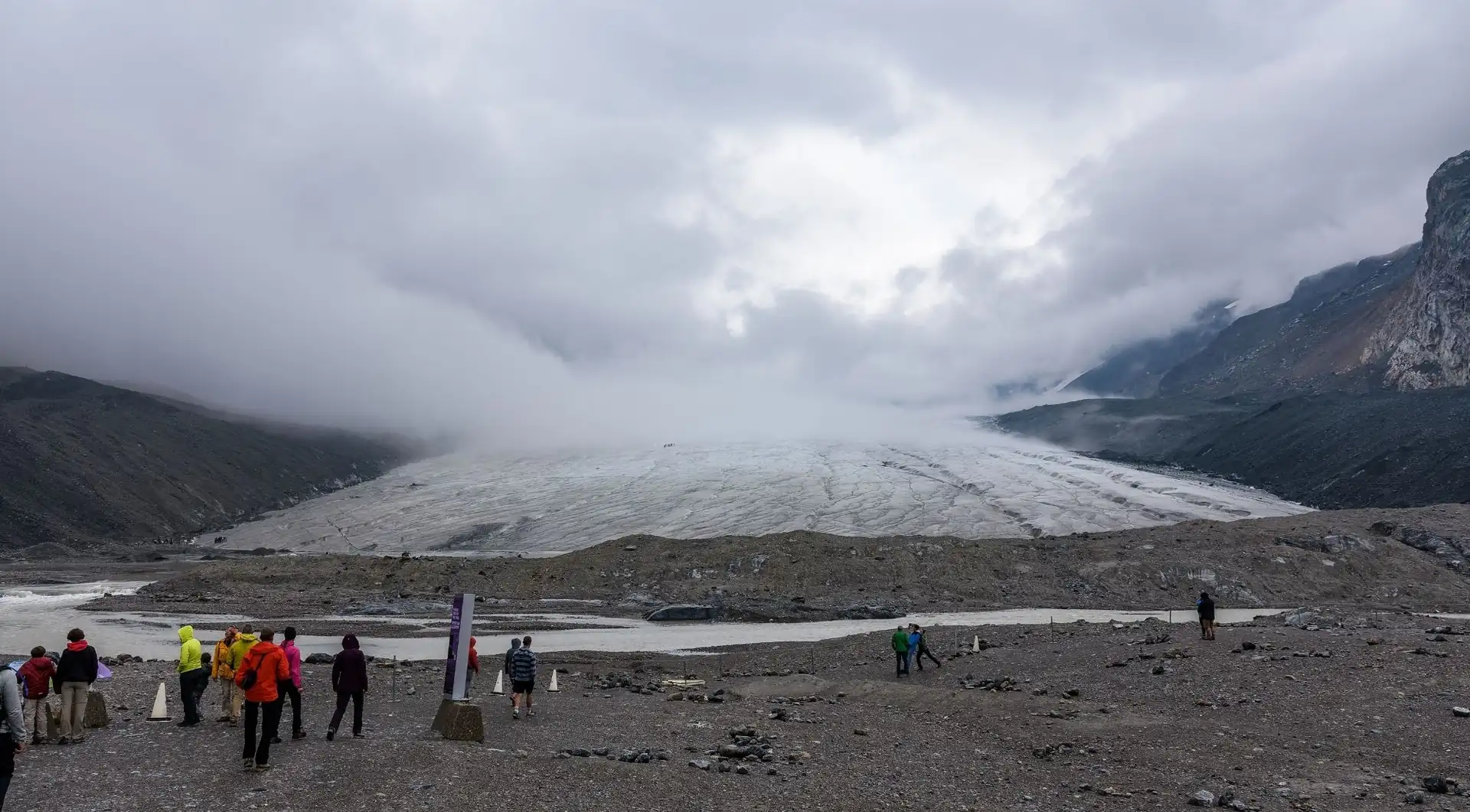
Take the Toe of the Athabasca Glacier trail if you want proximity. It is about 1.5 km return over glacial rubble to a roped boundary at the ice edge, and the year markers along the way are the reason to walk it slowly — you are crossing ground the glacier occupied within living memory. Take Wilcox Pass if you want the photograph: roughly 3.4 km return and 175 m of climbing to the Parks Canada red chairs, and an elevated panorama across the Athabasca and Dome glaciers that the valley floor simply cannot offer. If you have a morning, do both.
What no free option gives you is the surface of the glacier itself. That boundary at the toe is not a revenue-protection measure — crevasses on the Athabasca can be bridged by thin snow and are invisible until you are through one, and people have died crossing it. Standing on the ice legally and safely means either the Ice Explorer or a licensed guided ice walk. If that is what you came for, our guide to which Columbia Icefield tour to book compares every option. If it is not, keep your $96.
Check Guided IceWalk Availability
The free trails stop at the rope. This is the option that walks past it — ACMG-certified guides, micro-spikes and boots supplied, and hours on the glacier rather than minutes.
Walking to the Athabasca Glacier: 2 Trails, 5 km, No Ticket
From the lower Jasper-side car park to the red chairs at Wilcox Pass — where each trail starts, what it costs you in effort, and what you see.
-
Park at the Toe of the Glacier lot
It is on the Jasper side of the Icefields Parkway, across the highway from the Discovery Centre and signposted. Parking is free, and there are vault toilets at the trailhead but no other facilities.
-
Walk the year markers up the moraine
The path climbs gently over rubble the glacier left behind, past posts marking where the ice stood in past decades. The gap between the earliest marker and today’s ice edge is the whole climate story in one walk.
-
Stop at the rope, and do not cross it
You reach the toe itself — close enough to see meltwater channels and the debris in the ice. The barrier is where the free walk ends. Hidden crevasses beyond it have killed unprepared visitors. Allow about an hour for the round trip.
-
Drive to the Wilcox Creek trailhead
A few minutes south, off the Wilcox Creek Campground access road at about 2,040 m. The first section is the steep part — more than 100 m of gain inside the first kilometre, at altitude, so pace it.
-
Climb to the red chairs for the view
About 1.5 to 2 hours return for roughly 3.4 km, ending at the Parks Canada red chairs looking straight across at the Athabasca and Dome glaciers. Bighorn sheep are common here. Continuing to Wilcox Viewpoint roughly triples the distance.
You still need a Parks Canada pass. The trails are free, but driving the Icefields Parkway is not: about $11 per adult per day, or roughly $83.50 for an annual Discovery Pass, with under-18s free. It is checked, and it is the only unavoidable cost of a free glacier day.
The free trails pair well with the rest of the Icefields Parkway — Peyto Lake, Bow Lake, Mistaya Canyon, Athabasca Falls and Sunwapta Falls are all roadside stops between Lake Louise and Jasper.
Seeing the Athabasca Glacier for Free: FAQ
Distances, access rules and the hard safety limit, updated 4 September 2026.
Can you walk on the Athabasca Glacier without a tour?
No. You may walk toward the glacier on the free Toe of the Athabasca Glacier trail, but you must not cross the barriers onto the ice itself. Crevasses can be hidden beneath thin snow bridges and are invisible from the surface, and visitors have died attempting it. Stepping onto the ice legally and safely requires either the Ice Explorer or a licensed guided ice walk.
How long is the Toe of the Athabasca Glacier trail?
About 1.5 km return with minimal elevation gain, and roughly an hour if you stop at the markers. It starts from the lower car park on the Jasper side of the Icefields Parkway, across the highway from the Glacier Discovery Centre. Parking is free and there are vault toilets at the trailhead.
Is Wilcox Pass better than the Toe of the Glacier trail?
For the view, yes. Wilcox Pass climbs above the valley and gives an elevated panorama across the Athabasca and Dome glaciers that you cannot get from the valley floor — roughly 3.4 to 3.5 km return to the Parks Canada red chairs, with about 175 m of gain. The Toe trail is the one that gets you close to the ice edge. Many people do both in a morning.
Do you need to pay anything to see the Athabasca Glacier?
Only the Parks Canada pass required to drive the Icefields Parkway — about $11 per adult per day, or roughly $83.50 for an annual Discovery Pass, with under-18s free. Both the Toe of the Glacier and Wilcox Creek car parks are free, and both trails are free. You pay only if you want to get onto the ice.
How close does the free trail get you to the glacier?
Close enough to stand at the ice edge and see the surface texture, meltwater channels and the debris the glacier carries. The trail ends at a roped boundary at the toe. What it cannot give you is the view from on top of the glacier, which is what the Ice Explorer and the guided ice walk sell.
Can you see the glacier retreat from the trail?
Yes, and it is the most striking thing about the walk. Year markers along the approach show where the ice reached in past decades, so you cover on foot the ground the glacier has given up. NASA records the Athabasca Glacier as having lost about half its volume and receded more than 1.5 km in 125 years, and at its 1840s maximum the ice reached roughly where the Discovery Centre car park now sits.